
Compliments of
 Alan Van Zee
President | NMLS #: 297154
Hawaii Mortgage Company, Inc.
Company NMLS #: 232582
Alan Van Zee is one of the top producing Mortgage Originators in the state, originating over $2,000,000,000 to date. He has written and published this weekly newsletter for the past 18 years. It is the most widely read mortgage, real estate, and finance publication in Hawaii.
Hawaii Mortgage Company, now in our 26th year of providing mortgages to the people of Hawaii, is proud to have a complaint-free history. We make sure our clients are happy!
News and Insight
For the Weekend of March 28th, 2026
Hawaii’s Most Read Mortgage, Real Estate, and Finance Publication for 18 Years
Volume 18 – Issue 26
Flooding Isn’t New
I doubt a single individual avoided problems with the back-to-back storms we faced the past two weeks. But calls to sue oil companies are grossly irresponsible. I was lucky that a roommate from my early years was a geologist that specialized in Hawaii’s geology. I learned a lot, studied it myself, and thought I would share with you a little of Hawaii’s geologic history. It may make you think twice of where to set down your roots in our beautiful island home.
I won’t bore you with how the islands were formed, as most people already know there’s a hotspot on the ocean floor that’s been feeding the creation of our islands for millions of years. As the pacific plate moves northwest, a new island will eventually emerge to the Southeast of Hawaii island.
But with the damage and destruction encountered by our state with this recent spell of intense rain, I thought it would be interesting to share with you Hawaii’s dramatic tale or erosion!
If one were to stand on a beach anywhere on Oahu and look inland towards the mountains, you’d be amazed to know what you’re looking at is only one-third what was here before nature started eroding it away.
The older our islands become, the more they are subject to large-scale erosion. This is nothing new. It’s been going on for millions of years. We’re all familiar with the small islands and atolls to our northeast that are part of our Hawaiian chain. They were formed long before our main eight islands. Those islands will one day erode away completely.
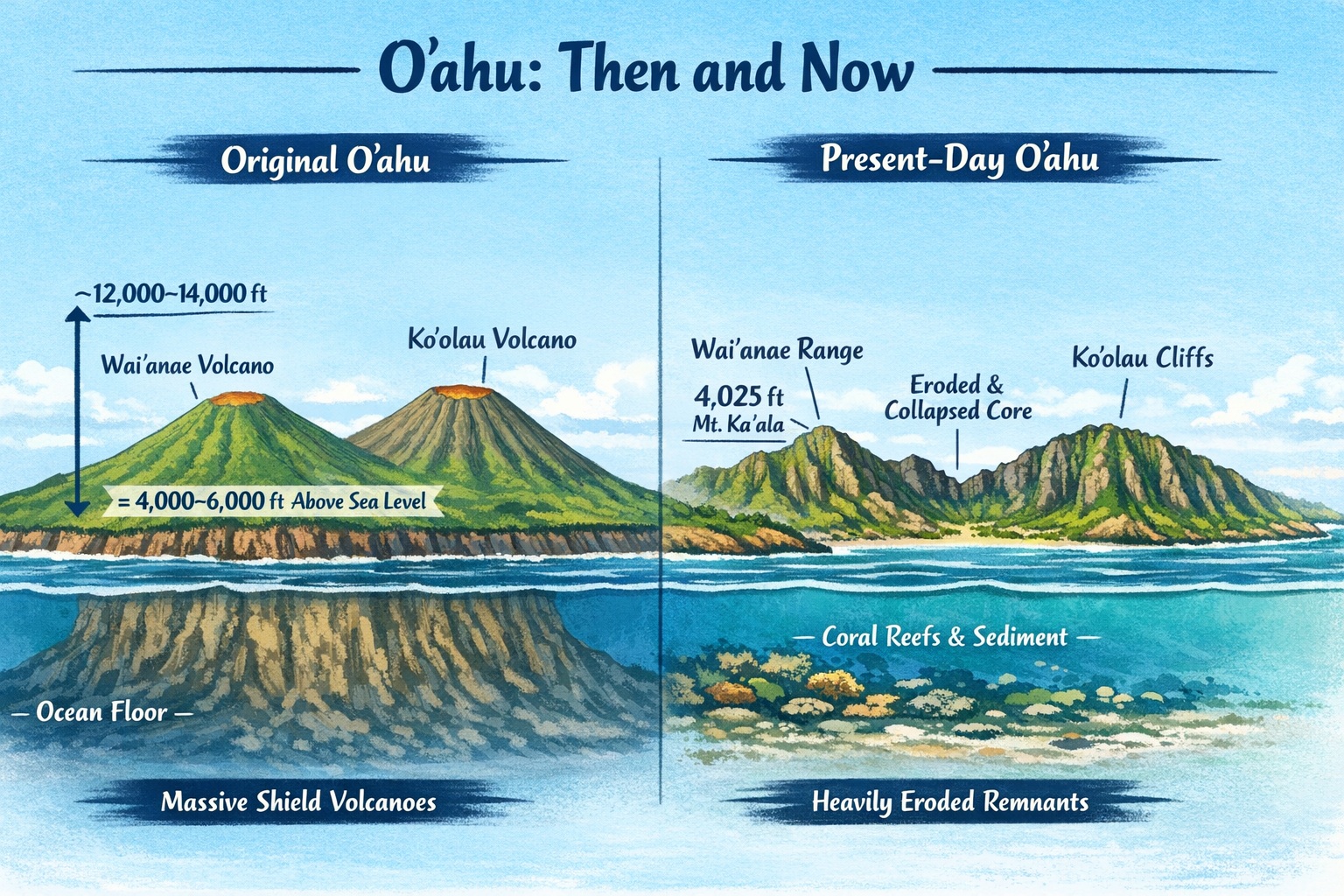
Geologists believe Oahu’s two volcanoes that formed the Koolau and Waianae ranges were once nearly 6,000 feet above sea level. Today, Mt. Kaala on the Waianae range is Oahu’s highest peak at 4,025 feet. But more dramatically, now much of the land surrounding each volcano is no longer there. Every valley on every island in our chain was once solid rock - yet eroded away over the last several million years.
The dramatic cliffs of the Koolau on Oahu were formed due to a massive landslide known as the Nuuanu Slide, that removed most of the original Koolau volcano. The landslide remnants extend over 140 miles from what’s now the beaches of Kailua and Waimanalo.
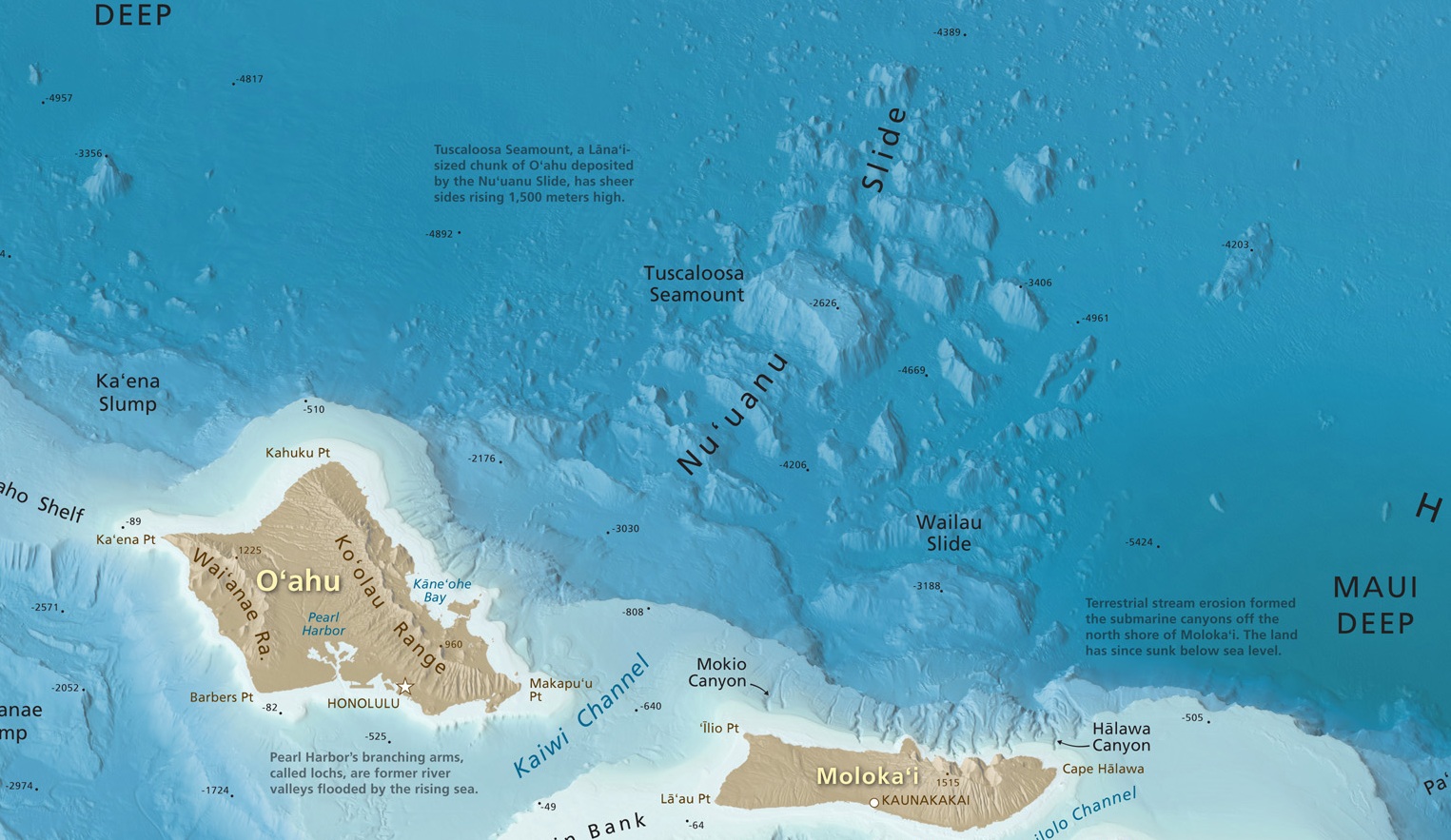
To illustrate how much land was lost, look at the picture above. Just to the northeast of Oahu there’s a feature known as the Tuscaloosa Sea Mount. That remnant of Oahu’s Koolau volcano is nearly the size of the current island of Lanai, with sheer sides 4,500 feet high. Molokai had a huge slide of their own – known as the Wailau Slide. That slide is how Molokai’s scenic north cliffs were formed. As a side note, scientists believe the Nuuanu slide resulted in massive Pacific-wide tsunami with a height of 500 feet!
What did Oahu look like before the Nuuanu Slide? The drawing below is the best conclusion of scientists

The reason for the geology lesson today is to illustrate that these relatively young geological formations we live on are subject to intense change and erosion. While there’s no longer a threat from a large chunk of Oahu falling off into the sea, the island is still subject to intense erosion.
What we all experienced will not stop. It was not a one-off storm. Hawaii’s geological history is filled with events like the storms of March 2026. We also need to recognize that the infrastructure in place is incapable of protecting the homes in many parts of Oahu. The same can be said for the neighbor islands.
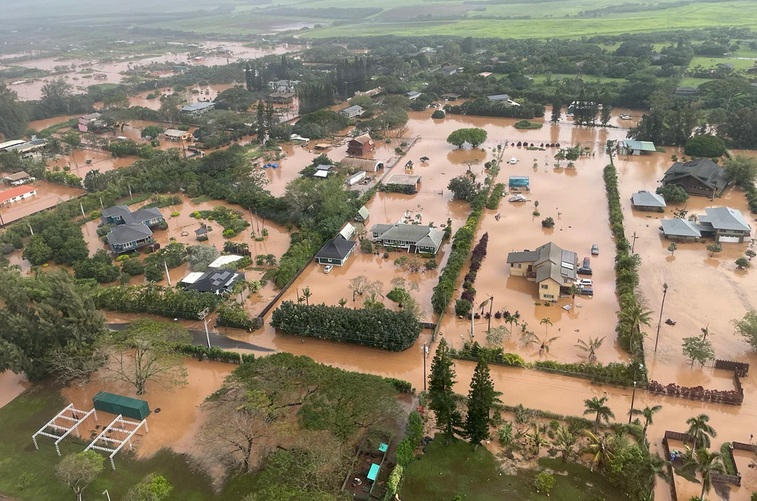
Where we decide to live is as much of a cultural decision as it is economic. But for those people in Wailua on Oahu, how many floods will it take before choosing to move to higher ground? Otake Camp in Wailua has been the recipient of multiple storm related flooding events. 1998, 2008 and then 2015 were particularly devastating.
For the rest of us outside the areas affected by the recent storms, take a clear assessment of areas around your home that were impacted by the rain. Are there barriers you can install? Gutters or other means of moving water away from your home? Is your exit from your neighborhood impeded by floodwaters? Now is the time – with the visions fresh in our minds, of what we need to do before the next storm.
And now the week’s economic news…….
Spotlight on Oil
Most of the movement in mortgage markets this week again was guided by changes in oil prices. It was a very light week for major economic data. As a result, mortgage rates climbed a bit to their highest levels in about eight months. Bond traders seemed to only focus on updated from the Gulf of Hormuz, yet there was other economic news that took a back seat.
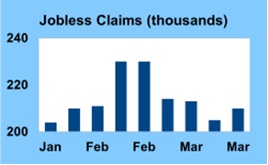 The Department of Labor releases the total number of new claims for unemployment insurance each week. The latest reading was just 210,000, matching the consensus forecast. Bigger picture, this was far below the inflated figures seen during the early months of the pandemic, and in line with the levels which were typical during the solid labor market in 2019. Weekly jobless claims are important because they are one of the timeliest indicators of labor market trends.
While other recent economic reports suggest that companies are scaling back on adding new employees, this report indicates that they remain reluctant to lay off workers. In short, the economy is in a "low-hire, low-fire" period, magnified by the conflict in the Middle East. Employers are hiring at their lowest rates since 2013 (except for a period early in the pandemic). Lacking confidence in their ability to find a better job, workers are quitting at the lowest rates in about ten years. Increased uncertainty about the duration of higher oil prices makes both employers and workers more hesitant to make major decisions. Bottom line, people wanting to change jobs and new entrants to the labor market such as college graduates are finding fewer opportunities.
Although the European Central Bank (ECB) held benchmark interest rates unchanged at 2.0% at its meeting last week, recent comments from top officials have warned that rate hikes are a possibility depending on the inflationary impact of higher oil prices. The meeting statement noted that the outlook is "significantly more uncertain" due to the conflict in the Middle East. ECB President Lagarde said this week that even a "not-too-persistent" rise in inflation from the oil shock could lead to a rate hike later in the year. As a result, long-term bond yields in Europe reached their highest levels in about eleven years.
Next Week
Looking ahead, attention will remain fixed on the conflict in the Middle East. Investors also will monitor comments from Fed officials about future monetary policy and from government officials about tariffs. For economic reports, JOLTS and Consumer Confidence will come out on Tuesday. The ISM national manufacturing sector index will be released on Wednesday and the services sector index on Friday. The key Employment report also will be released on Friday, and these figures on the number of jobs, the unemployment rate, and wage inflation are always closely watched.
Until next week….

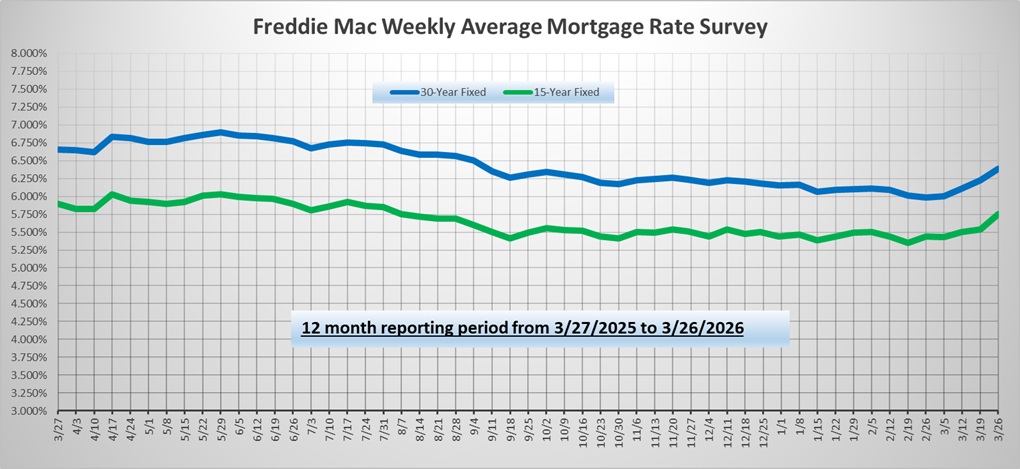
*** Please note that Freddie Mac publishes their weekly rate report on Wednesday mornings from data received Monday and Tuesday.
The graph above is intended to shown rate trends, and not “today’s current rate”. ***
Reviews From Our Past Clients
With every client, we promise to provide you with a comprehensive analysis of your mortgage needs, the best service possible, and the best rates we can find. We make it our mission to have every transaction close with our clients happy with the service we provided. Browse through the hundreds of reviews we’ve received from our clients posted on both Google and Zillow.com, and read what they thought of their experience using Hawaii Mortgage Company.
Google Link:
Hawaii Mortgage Company Review on Google.com
Zillow.com Link:
Hawaii Mortgage Company Reviews on Zillow.com
Our Rate Quote System is Available to You
Our automated rate quoting system is live. Now you can check rates and try different scenarios 24-hours a day. Remember, it’s just a computer. For non-standard rate quotes, such as construction, vacant land, and other specialty programs, you’ll still need to give a call.
Here’s the link: https://www.hawaiimortgage.net/todays-rates/

Do you think all lenders are the same?
There is a difference when you use Hawaii Mortgage Company for your financing. Here’s a short video telling you why:

Broker vs. Banker?
Click the link below to get a quick lesson on why working with a Mortgage Broker will benefit you on your next transaction.


