

Compliments of
 Alan Van Zee
President | NMLS #: 297154
Hawaii Mortgage Company, Inc.
Company NMLS #: 232582
Alan Van Zee is one of the top producing Mortgage Originators in the state, originating over $2,000,000,000 to date. He has written and published this weekly newsletter for the past 19 years. It is the most widely read mortgage, real estate, and finance publication in Hawaii.
Hawaii Mortgage Company, now in our 28th year of providing mortgages to the people of Hawaii, is proud to have a complaint-free history. We make sure our clients are happy!
News and Insight
For the Weekend of October 3rd, 2026
Hawaii’s Most Read Mortgage, Real Estate, and Finance Publication for 18 Years
Volume 19 – Issue 6
Insight on Buying Points
Rates are rising and home sales have slowed down. Buyers are freaked out that rates have jumped over a half-percent since mid-August. This is the time when a savvy buyer will ask the seller to kick some $$$ into the transaction to help buy down the rate. That cost to provide you a lower interest rate is called points. The more points you pay, the lower the rate you’ll get on your mortgage. Today, let’s talk about buying points and how that will ultimately affect the interest rate you’ll get for your mortgage.
Let’s start with the basics. In simple math, each point is equal to 1% of the loan amount. If you are getting a $450,000 mortgage and the rate you were quoted will cost you 1-point, that cost is $4,500. 2-points, $9,000.

But what are points, and why do you need to pay them in order to get a lower rate? To answer that, you’ll need to understand in basic terms how and where the money for your transaction comes from. In almost all circumstances, the “lender” offering you the mortgage is getting the money from another source. For most loans, Fannie Mae and Freddie Mac are that source. FHA and VA loans are funded by Ginnie Mae – the government loan equivalent to Fannie and Freddie. Each day Fannie, Freddie, and Ginnie take all the mortgages they bought from lenders across the country and unload them on the bond market. The people buying the bonds and what they are willing to pay for them is what sets mortgage rates offered to consumers.
These bond traders when determining the price of a mortgage bond, known as Mortgage-Backed Securities (MBS), take into consideration many different global factors. Part of that analysis is to determine their long-term return on investment at various interest rates. Since a lower interest rate will earn them a lower return, they demand some money upfront to compensate for that shortfall. The lower the rate, the more upfront money they’ll require to buy that bond. In the most simplistic terms, that’s where points come from.
It is important to note that there’s no established formula for how much you’ll pay in points to get a lower rate. It’s not as simple as: for every half-point you pay, the rate will drop by a certain amount. The technical term is called the yield spread, and it isn’t uniform. For us on the rate quoting side of the transaction, we need to dig deep to see if there is an outlier that could be advantageous to our client.
Let me give you an example. Below is a rate quote for a Fannie/Freddie product. This is the exact information I give my clients when evaluating rates. It is not only important to know the amount of points you’ll pay, but how much that cost will lower your monthly payment. And the most important calculation in the whole spreadsheet is the last column – how long will it take you to recapture the money you paid in points because of the lower monthly payment.

If I were reviewing this rate quote with my clients, I would point out that if they took the 7.500% rate, they would recapture the $1,665 in points in 34.5 months – just under 3 years. That’s the best deal of them all. None of the other rate options seem to be worth it, because they all will take nearly 5 years to recapture the upfront points cost. It is important to point out that the rates in the middle have a longer recapture time than the lowest rates offered.
Let’s look at one more example for VA financing.

In this example, you actually see a lower rate costing less points than a higher rate. That’s not a typo. The 6.990% rate will cost less points than the 7.000% rate. Would I recommend a borrower pay $3,225 to save $68 per month? That’s a decision I leave up to the borrower, and a discussion of where rates are headed for another newsletter article.
Here’s the takeaway for today. If you are shopping for rates, or now in the process if obtaining mortgage financing, find a lender that will provide you with the details above. Without it, you’re flying blind.
And now the week’s economic news…….
Job Gains Fall Short
Headlines surrounding the conflict in the Middle East continued to create some ups and downs in mortgage markets this week. A surprisingly weak jobs report also grabbed attention, although it had less of an impact on mortgage rates than you might expect. By the end of the week, mortgage rates were slightly higher.
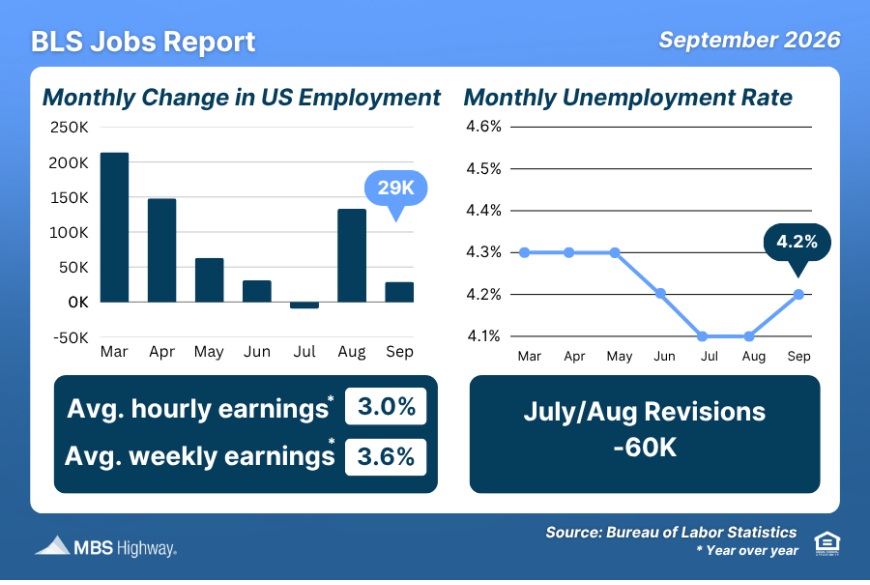 In September, the U.S. economy gained just 29,000 jobs, the fewest since July, surprising economists who had expected employers to add 85,000 jobs. On top of that, payroll numbers for the previous two months were revised lower by a combined 60,000 jobs. The largest gains were seen in health care and construction, while temporary help services and information services lost jobs.
In addition to the weak headline number, some of the other key components of the report also were softer than expected. Average hourly earnings rose just 0.1% for the month, bringing annual wage growth to 3.0%. That's down slightly from 3.1% the month before and marks the slowest annual increase since May 2021. Wage growth is barely keeping up with the inflation rate. The unemployment rate climbed to 4.2%, above the consensus forecast for a flat reading of 4.1%. One encouraging sign in the report was that the participation rate (the percentage of working-age people in the labor force) improved. After hitting its lowest level since March 2021 two months ago, participation has picked up as significantly more people have entered the workforce.
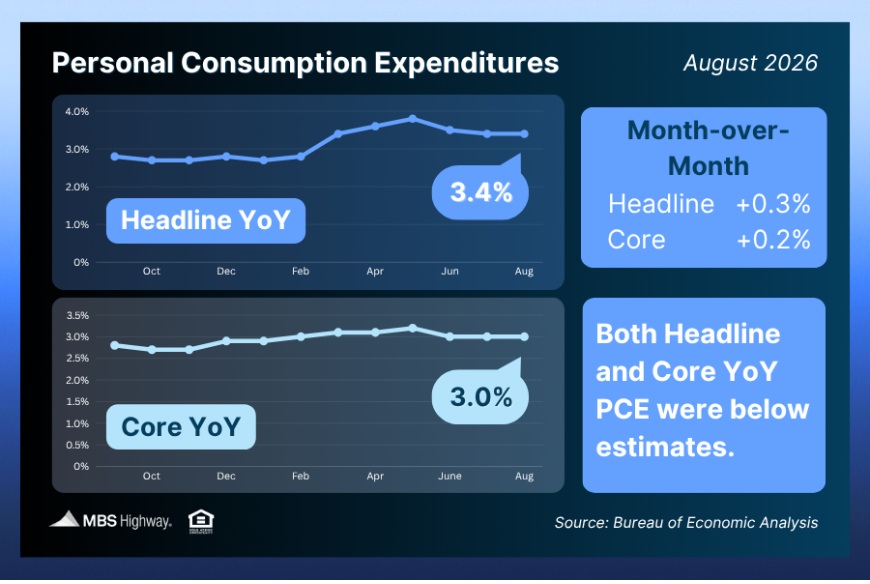 While the labor market is showing signs of cooling, inflation continues to be something the Federal Reserve is watching closely, and the PCE price index is their favored indicator. In August, core PCE, which excludes the volatile food and energy components, was 3.0% higher than a year ago, the same annual rate as July. Progress toward the 2.0% target of the Fed has been challenging, and this level has not been seen since February 2021. Following the latest labor market and inflation data, most investors now anticipate that the Fed will hold steady at the October meeting and then hike rates at the December meeting.
Bottom Line: For now, investors are balancing several competing forces: slowing economic growth, persistent inflation, and continued global uncertainty. Inflation has come down significantly from its peak, but it's still well above the Federal Reserve's target. That means the Fed is likely to remain cautious about its next moves. For mortgage rates, that could mean more volatility in the weeks ahead. Daily movements will continue to depend on incoming economic data, comments from the Federal Reserve, and developments around the world.
Next Week
Looking ahead, attention will remain fixed on the conflict in the Middle East and oil prices. Investors also will monitor comments from Fed officials about future monetary policy. The detailed minutes from the September 16 Fed meeting will come out on Wednesday. It will be a light week for economic reports. The ISM national services sector index will come out on Monday. The Trade Deficit will be released on Tuesday.
Until next week….

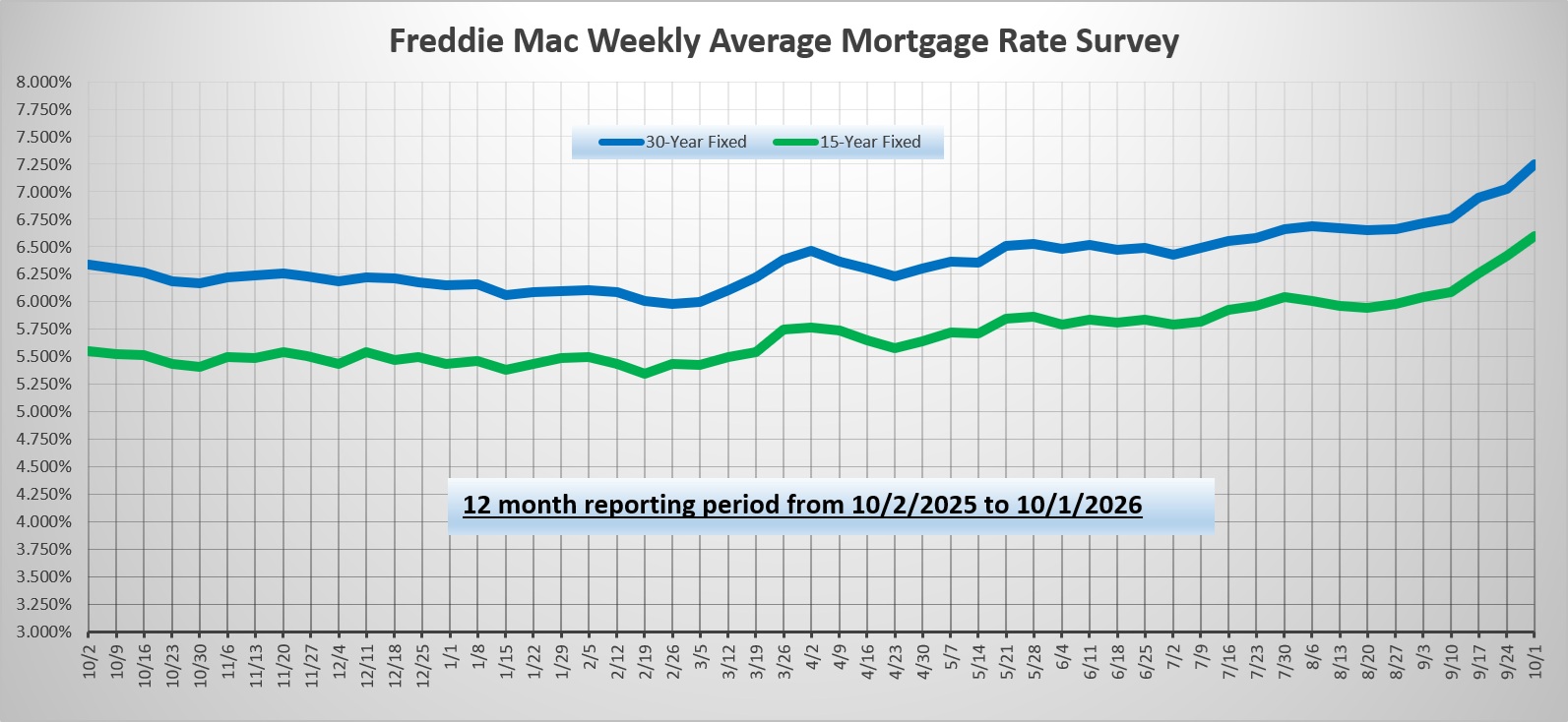
*** Please note that Freddie Mac publishes their weekly rate report on Wednesday mornings from data received Monday and Tuesday.
The graph above is intended to shown rate trends, and not “today’s current rate”. ***
Reviews From Our Past Clients
With every client, we promise to provide you with a comprehensive analysis of your mortgage needs, the best service possible, and the best rates we can find. We make it our mission to have every transaction close with our clients happy with the service we provided. Browse through the hundreds of reviews we’ve received from our clients posted on both Google and Zillow.com, and read what they thought of their experience using Hawaii Mortgage Company.
Google Link:
Hawaii Mortgage Company Review on Google.com
Zillow.com Link:
Hawaii Mortgage Company Reviews on Zillow.com
Our Rate Quote System is Available to You
Our automated rate quoting system is live. Now you can check rates and try different scenarios 24-hours a day. Remember, it’s just a computer. For non-standard rate quotes, such as construction, vacant land, and other specialty programs, you’ll still need to give a call.
Here’s the link: https://www.hawaiimortgage.net/todays-rates/

Do you think all lenders are the same?
There is a difference when you use Hawaii Mortgage Company for your financing. Here’s a short video telling you why:

Broker vs. Banker?
Click the link below to get a quick lesson on why working with a Mortgage Broker will benefit you on your next transaction.


