

Compliments of
 Alan Van Zee
President | NMLS #: 297154
Hawaii Mortgage Company, Inc.
Company NMLS #: 232582
Alan Van Zee is one of the top producing Mortgage Originators in the state, originating over $2,000,000,000 to date. He has written and published this weekly newsletter for the past 19 years. It is the most widely read mortgage, real estate, and finance publication in Hawaii.
Hawaii Mortgage Company, now in our 28th year of providing mortgages to the people of Hawaii, is proud to have a complaint-free history. We make sure our clients are happy!
News and Insight
For the Weekend of October 24th, 2026
Hawaii’s Most Read Mortgage, Real Estate, and Finance Publication for 18 Years
Volume 19 – Issue 9
Eight Honolulu Charter Amendments That Could Affect Housing, Real Estate, and City Finances
On November 3, Oahu voters will be asked to decide on 20 proposed amendments to the Charter of the City and County of Honolulu. While some of these measures involve the organization and administration of city government, others address housing availability, affordable housing funding, real estate transactions, and the allocation of property tax revenues. I reviewed all 20 proposals and identified eight that have a direct connection to real estate or municipal finances. For each measure, I've included an explanation of what would change, followed by my own observations and concerns. My purpose is to help you understand what is being proposed and the potential consequences, particularly when it comes to how our government manages public money.

Question 1 — Food Security Fund
The proposal: Establish a new Food Security Fund supported by an annual allocation of property tax revenues, increasing the combined allocation to the City's special funds from 2.5% to 3%. Each of the six funds would receive an equal share.
The fund would support programs providing locally grown or produced food to Oahu residents, with provisions for non-local food during emergencies. The amendment would not require an accompanying increase in property tax rates. However, dedicating more property tax revenue to special funds would reduce the amount available for other purposes unless offset elsewhere in the budget.
My Analysis:
We all want to see more locally grown products and greater food security in Hawaii. However, I question why we need a Charter amendment to accomplish something our elected officials should already be addressing. The City has other options available, including tax incentives and existing government programs, to encourage local agriculture and food production. My concern is establishing another permanent special fund rather than requiring our elected officials to make these decisions through the regular budget process. We elect representatives to establish spending priorities, and we should hold them accountable for those decisions.
Question 7 — Housing Availability
The proposal: Amend the City Charter to establish increasing housing availability and preserving existing housing as official policies of the City and County of Honolulu.
The amendment would formally recognize Honolulu's housing shortage and the consequences of residents leaving Hawaii because they cannot afford housing. However, it would not directly authorize construction, change zoning regulations, appropriate additional money, or guarantee that additional housing will be built.
My Analysis:
This is what I would describe as a feel-good amendment. It adds language to the City's policies recognizing the importance of increasing housing availability and preserving existing housing, but it doesn't guarantee that anything will actually be done. We already know that Hawaii has a housing affordability problem. Adding language to the Charter doesn't solve it. What matters is whether our elected officials follow through with meaningful action.
Question 8 — Affordable Housing Fund
The proposal: Clarify that the City's Affordable Housing Fund operates as a revolving fund, requiring loan repayments, interest, earnings, proceeds, and other receipts generated by the fund to be returned to it.
Existing unused fund balances already carry forward from year to year. This amendment would expressly require repayments, interest, and other proceeds generated by the fund to remain there as well. The amendment would also provide additional flexibility for financing qualifying affordable housing within mixed-use and mixed-income developments. The objective is to allow money generated by previous housing investments to be used again for future affordable housing projects.
My Analysis:
I am not a fan of special funds, particularly when money is automatically returned to them without being reconsidered through the normal budget process. I don't believe government funding decisions should ever be automatic. Our elected representatives are responsible for determining how taxpayer dollars should be allocated. Those decisions should be reviewed regularly, with consideration given to changing priorities and needs. When money is automatically directed into a particular fund, it reduces the opportunity for elected officials to reconsider whether that remains the most appropriate use of public resources. Ultimately, voters need to hold their elected representatives responsible for being good stewards of our tax dollars.
Question 9 — Public Hearings for City Real Estate Transactions
The proposal: Eliminate the requirement for a separate departmental public hearing on transactions involving City real estate interests.
These transactions can range from relatively minor matters, such as utility easements, to more significant property transactions. The public would still have an opportunity to testify when transactions come before the City Council. The proposal would eliminate the additional hearing requirement, potentially reducing administrative costs and delays.
My Analysis:
I believe the public should always be given opportunities to voice their opinions on matters before the City, particularly when those matters involve public property. Public participation is one of the fundamental principles of representative government. While eliminating an additional hearing might reduce administrative costs or make the process more efficient, I question whether that benefit justifies reducing opportunities for public participation. Our government should be encouraging public involvement, not limiting it.
Question 10 — Long-Term Affordable Housing Plan
The proposal: Require the City to prepare and implement a ten-year affordable housing functional plan, updated at least every five years.
The requirement would take effect January 1, 2030. The plan would help guide housing policies, infrastructure investments, and future budget decisions. However, the amendment would not itself appropriate additional funding or guarantee the construction of new housing.
My Analysis:
Why do we need a Charter amendment to require our elected representatives to do something they should already be doing? Addressing Hawaii's housing shortage should already be one of the City's responsibilities. My concern is that requiring another formal planning process could lead to additional administrative expenses and bureaucracy without necessarily producing more housing. Rather than creating another requirement in the Charter, we should be demanding that our elected officials direct existing City agencies to develop and implement meaningful housing solutions. We don't necessarily need more government planning requirements. We need our existing government agencies to accomplish the objectives they are already responsible for addressing.
Question 12 — Additional Funding for City Special Funds
The proposal: Allow the Clean Water and Natural Lands Fund, Affordable Housing Fund, Climate Resiliency Fund, and other Charter-established special funds to receive money from federal, state, philanthropic, and other sources.
Currently, these funds receive dedicated allocations from City property tax revenues. The amendment would expand the sources from which they could receive additional funding. The proposed language retains existing administrative and expenditure restrictions, but does not expressly require City Council approval of every individual outside contribution.
My Analysis:
My concern with this amendment goes beyond the existence of special funds. We elect representatives to make fiscal decisions on our behalf. When funding arrangements allow money to flow directly into dedicated funds, I question whether our elected officials retain sufficient control over those decisions. The proposed amendment does not expressly require the City Council to approve each individual contribution. While existing rules continue to govern how money can be spent, I believe there is an important distinction between oversight of expenditures and accountability for how money enters a government fund. The question is whether the public can continue to hold elected officials fully accountable for fiscal decisions when funding can come directly from outside organizations.
Question 13 — Historic Preservation and Land Conservation
The proposal: Expand the permitted uses of the Clean Water and Natural Lands Fund to include additional historic preservation activities, including restoration, maintenance, and rehabilitation of historic buildings, archaeological resources, and culturally significant sites and objects.
The amendment would also rename the fund and modify the responsibilities of commissions reviewing funding proposals. Historic preservation is already among the fund's purposes, but the amendment would broaden the types of preservation expenses that could be financed.
My Analysis:
My concern is that money originally allocated for one purpose can subsequently be used for purposes that were not contemplated when the fund was established. While historic preservation is certainly important, expanding the authorized uses of an existing fund creates additional demands on the same financial resources. Money used for one purpose is money that may no longer be available for another. This raises a broader question about special funds and whether their original objectives can gradually change without the same scrutiny that would accompany decisions made through the regular budget process.
Question 14 — Maintenance of City-Owned Conservation Lands
The proposal: Increase the maximum annual allocation for operating, maintaining, and managing lands acquired through the Clean Water and Natural Lands Fund from 5% to 10% of the previous year's deposits.
For example, if the fund received $9 million during the preceding year, the maximum allocation for these purposes would increase from $450,000 to $900,000. The amendment would permit greater maintenance spending but would not automatically increase the fund's revenues.
My Analysis:
Our City has a poor history, in my opinion, of acquiring properties and facilities and then failing to maintain them adequately. I certainly recognize the importance of maintaining and rehabilitating properties the City already owns. However, increasing the amount of money that can be used for maintenance creates a financial tradeoff. Either less money may be available for future acquisitions, or there could be greater pressure to increase the overall funding available to the fund. These are precisely the types of decisions our elected representatives should be making through the regular budget process. Maintenance and rehabilitation are legitimate government expenses, but I believe they should be evaluated alongside other City priorities rather than handled through expanded spending authority within a special fund.
A Common Theme: Government Accountability
Looking at these eight amendments, several raise a recurring question about how our government makes financial decisions. I believe we elect representatives to establish priorities, allocate public resources, and make difficult decisions about competing needs. When spending decisions become automatic or are embedded in permanent funding arrangements, there is a risk that elected officials have less flexibility to respond to changing circumstances. Just as importantly, it may become more difficult for voters to determine who is responsible for those decisions.
Whether we're discussing affordable housing, food security, historic preservation, or maintaining public property, these are important objectives that deserve attention. But supporting an objective and supporting a particular government funding mechanism are not necessarily the same thing.
The complete ballot questions, explanations, and proposed Charter amendments are available through the Honolulu City Council's official website: https://www.honolulucitycouncil.org/oahuvotes
And now the week’s economic news…….
Home Sales Rise
Although oil prices climbed, it was another good week for mortgage markets. Investors continued shifting money out of riskier technology stocks and into safer investments, including bonds, helping push mortgage rates lower.
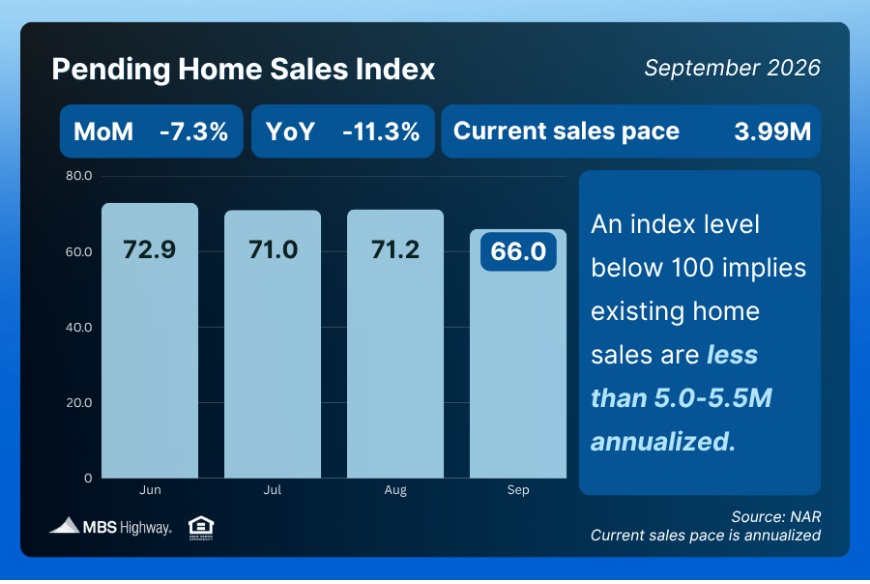 In September, sales of previously owned homes rose a little from August but still were a bit lower than a year ago. The median price of $417,500 was up 2% from last year at a record high for the month of September. Inventory remains one of the biggest challenges for buyers, but the recent trend has been positive. There is only about a 4.8-month supply of homes nationally. However, inventory was up 5% from a year ago, at the highest level since 2019.
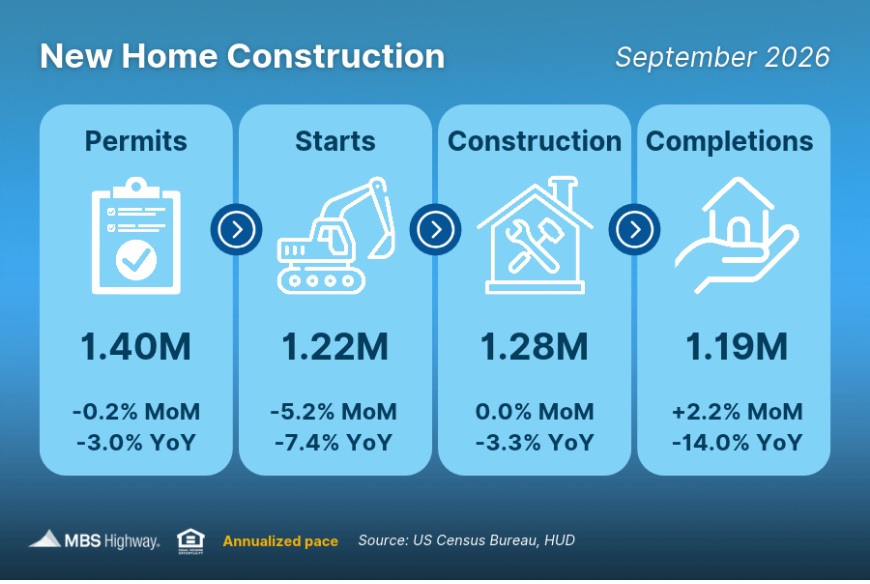 The latest home building data was not encouraging. Overall housing starts in September declined 5% from August, far more than expected, and are running 7% below last year's pace. Single-family starts declined to the lowest level since September 2025, while single-family building permits, a leading indicator of future construction, fell to the lowest level since 2023.
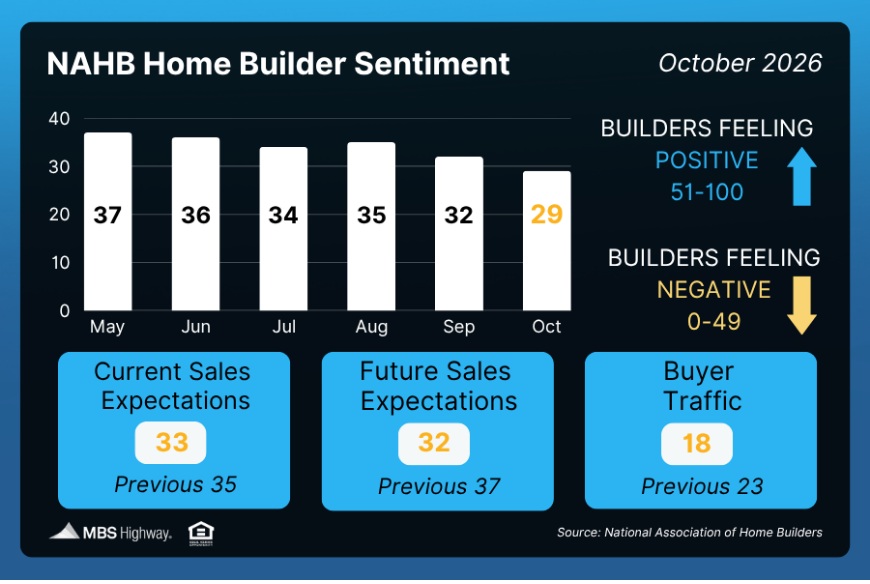 Finally, a survey of home builder sentiment on housing market conditions from the NAHB unexpectedly dropped to 29, the lowest level since 2012, and has remained in negative territory below 50 for thirty straight months. To help generate demand, 66% of builders offered sales incentives in September, while 43% reduced home prices, the most since 2020. Builders cited high mortgage rates, labor shortages, and rising material costs as significant obstacles to increasing new home supply.
The Big Picture: For now, mortgage rates remain caught between competing forces. Investors are continuing to weigh a mix of slowing economic data, stubborn inflation, and global uncertainty. As a result, mortgage rates will probably remain volatile from day to day as investors react to Fed comments, economic data, and geopolitical events. Meanwhile, the housing market continues to face a combination of limited inventory, affordability challenges, and cautious builders.
Next Week
Looking ahead, attention will remain fixed on the conflict in the Middle East and oil prices. The next Fed meeting will take place on Wednesday, and most investors anticipate that there will be no change in the federal funds rate. The next European Central Bank meeting will take place on Thursday. For economic reports, New Home Sales will come out on Tuesday. The PCE price index, the inflation indicator favored by the Fed, and third quarter GDP, the broadest measure of economic activity, will be released on Thursday.
Until next week….

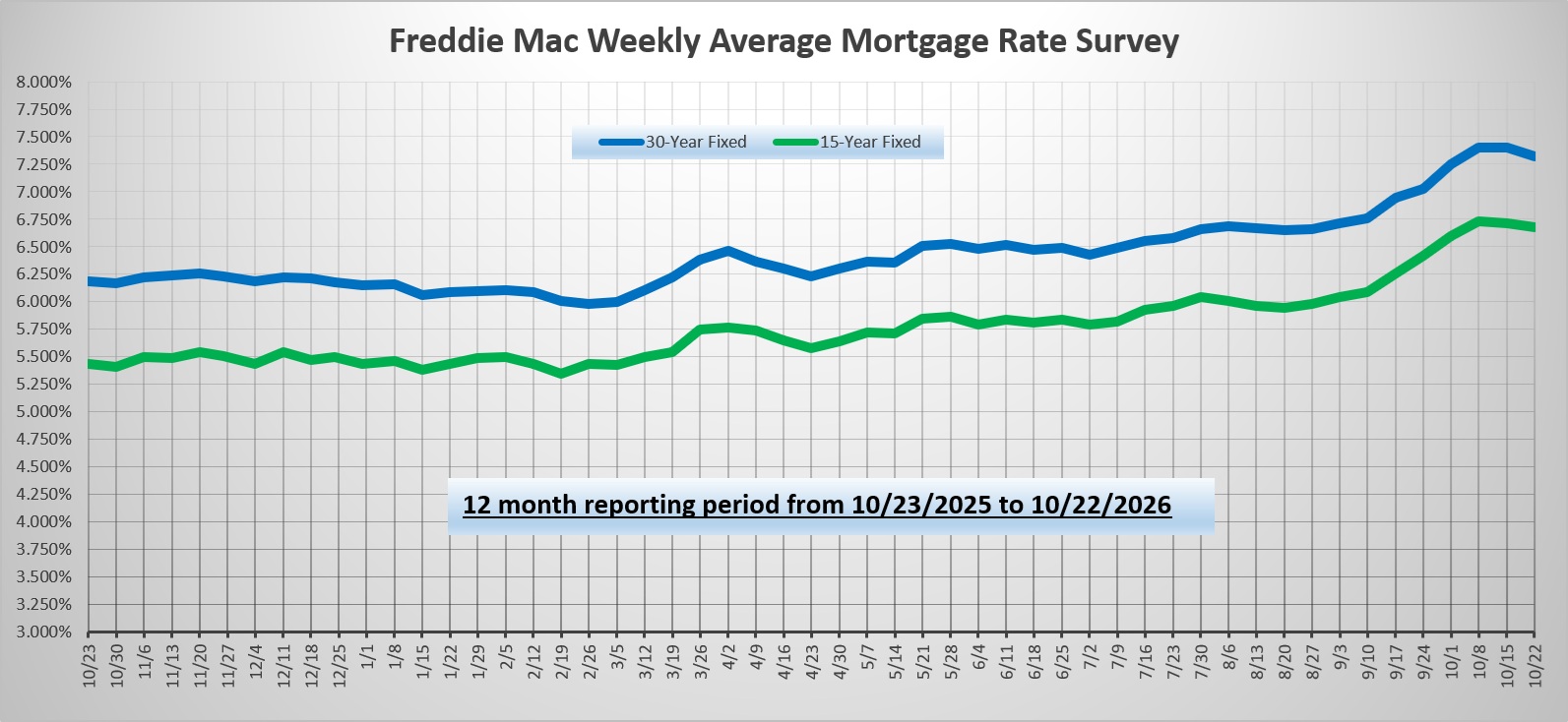
*** Please note that Freddie Mac publishes their weekly rate report on Wednesday mornings from data received Monday and Tuesday.
The graph above is intended to shown rate trends, and not “today’s current rate”. ***
Reviews From Our Past Clients
With every client, we promise to provide you with a comprehensive analysis of your mortgage needs, the best service possible, and the best rates we can find. We make it our mission to have every transaction close with our clients happy with the service we provided. Browse through the hundreds of reviews we’ve received from our clients posted on both Google and Zillow.com, and read what they thought of their experience using Hawaii Mortgage Company.
Google Link:
Hawaii Mortgage Company Review on Google.com
Zillow.com Link:
Hawaii Mortgage Company Reviews on Zillow.com
Our Rate Quote System is Available to You
Our automated rate quoting system is live. Now you can check rates and try different scenarios 24-hours a day. Remember, it’s just a computer. For non-standard rate quotes, such as construction, vacant land, and other specialty programs, you’ll still need to give a call.
Here’s the link: https://www.hawaiimortgage.net/todays-rates/

Do you think all lenders are the same?
There is a difference when you use Hawaii Mortgage Company for your financing. Here’s a short video telling you why:

Broker vs. Banker?
Click the link below to get a quick lesson on why working with a Mortgage Broker will benefit you on your next transaction.


