

Compliments of
 Alan Van Zee
President | NMLS #: 297154
Hawaii Mortgage Company, Inc.
Company NMLS #: 232582
Alan Van Zee is one of the top producing Mortgage Originators in the state, originating over $2,000,000,000 to date. He has written and published this weekly newsletter for the past 19 years. It is the most widely read mortgage, real estate, and finance publication in Hawaii.
Hawaii Mortgage Company, now in our 28th year of providing mortgages to the people of Hawaii, is proud to have a complaint-free history. We make sure our clients are happy!
News and Insight
For the Weekend of October 31st, 2026
Hawaii’s Most Read Mortgage, Real Estate, and Finance Publication for 18 Years
Volume 19 – Issue 10
Inflation Is Slowing. So Why Does Everything Still Cost So Much?
We keep hearing that inflation is coming down. Economists report it, politicians celebrate it, and the financial markets react to every new inflation report. But I suspect most of you are wondering why your grocery bills, insurance premiums, utility bills, and just about everything else you purchase continue to cost so much more than they did a few years ago. There's a simple explanation that I believe gets overlooked in much of the discussion about inflation. Inflation is cumulative, and every increase builds on all the increases that came before it. Even relatively modest inflation, sustained over a long period, can dramatically increase our cost of living.
The Compounding Effect of Inflation
Most of us understand how compound interest works. When we invest money, we earn interest on our original investment and then additional interest on the interest we've already earned. Inflation works much the same way, except the compounding works against us. Consider something that costs $100 today. With annual inflation of just 3%, that item will cost approximately $123 in seven years, $181 in 20 years, and $243 in 30 years. That's a 143% increase over 30 years, even though inflation never exceeded 3% annually. And when we experience periods of unusually high inflation, as we did following the pandemic, the cumulative effect becomes much more significant. Take a look at the accompanying chart showing price increases over a seven-year period:
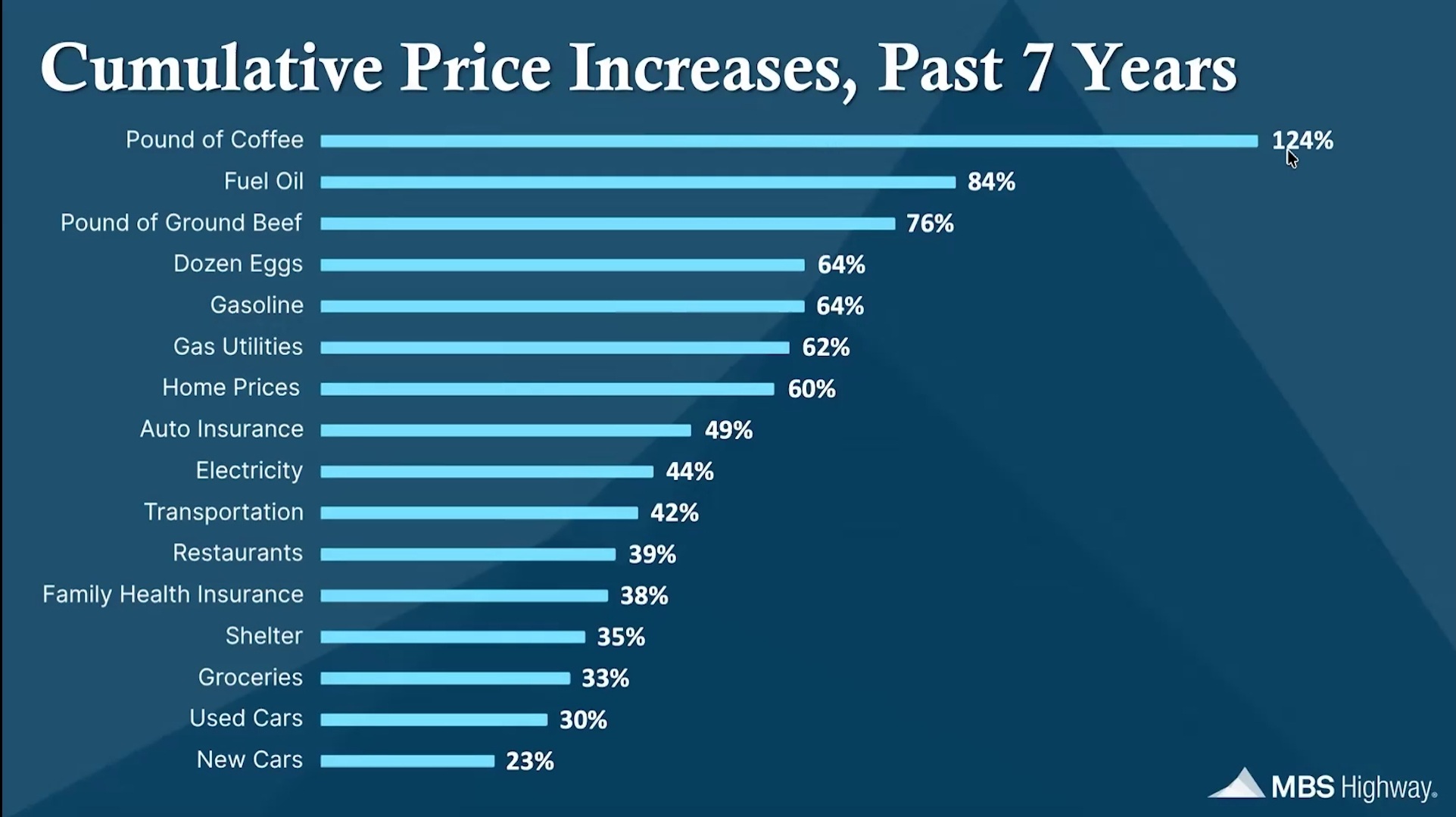
Coffee increased 124%, ground beef 76%, gasoline and eggs 64%, home prices 60%, auto insurance 49%, and groceries 33%. A family that previously spent $1,000 per month on groceries would now need approximately $1,330 to purchase the same amount of food, assuming their expenses followed that increase. That's almost $4,000 more annually for groceries alone. Now add the increased costs of housing, insurance, utilities, transportation, and everything else a family needs. It's no wonder so many Americans are frustrated with the economy.
Why Lower Inflation Doesn't Mean Lower Prices
This is where I believe much of the public discussion about inflation becomes misleading. When inflation declines from 6% to 3%, we're told that inflation has been reduced by half. That's mathematically correct, but it can give people the impression that the cost of living is somehow returning to normal. It isn't. If something previously cost $100 and now costs $140, reducing inflation to zero simply means the price remains at approximately $140. Getting that price back to $100 would require a decline of nearly 29%. Individual prices certainly can decline. We've all seen gasoline prices fluctuate, and the prices of certain foods and other commodities can fall when supplies increase. But a broad decline in prices throughout the economy would require deflation, which can create its own serious economic problems, including declining wages, reduced business investment, and higher unemployment. For the most part, the price increases we've experienced over the past several years have established a new starting point. And even if the Federal Reserve achieves its 2% inflation target, prices will continue increasing. At 2% annually, the general price level rises another 22% over ten years.
Can Government Spending Solve the Problem?
One of my concerns about our economic policies is the tendency to address affordability problems by spending more government money. Housing is a good example. When homes become unaffordable, politicians frequently propose additional down payment assistance, tax credits, or other subsidies to help people purchase homes. Some of these programs can certainly help individual families. But consider what happens when we provide more purchasing power to homebuyers without increasing the number of homes available for sale. We now have more buyers competing for the same limited housing inventory. Particularly in markets where new construction is difficult or restricted, some of that additional purchasing power can end up driving home prices even higher. I've spent nearly 30 years in the mortgage business, and I've seen firsthand how limited housing supply affects affordability.
The long-term solution requires increasing the supply of housing. That means addressing zoning restrictions, permitting delays, infrastructure limitations, construction costs, and other obstacles that make it difficult and expensive to build. The same economic principles apply to other parts of our economy. When government policies stimulate additional demand without corresponding increases in production, they can contribute to inflationary pressures.
And when government spending consistently exceeds revenue, the resulting deficits must be financed through additional borrowing. Over time, growing debt can put pressure on interest rates and reduce our ability to respond to future economic challenges. Certainly, some government spending is necessary and productive. Infrastructure, education, and other investments can strengthen the economy when they're properly managed. But we should be asking whether government programs actually address the underlying causes of higher costs and whether the benefits justify what taxpayers are being asked to spend.
What About the Federal Reserve?
The Federal Reserve has an important role in controlling inflation, primarily through monetary policy and interest rates. When inflation becomes excessive, raising interest rates can reduce borrowing and spending, which helps bring inflation under control. But there are limitations to what monetary policy can accomplish. Higher interest rates don't increase the number of homes available for sale, produce additional electricity, or improve the efficiency of our transportation system. In fact, higher borrowing costs can discourage businesses from making investments that would increase production. The Fed can help control inflation by managing demand, but many of the underlying problems that contribute to higher prices require solutions beyond monetary policy.
The Importance of Real Income Growth
I believe this is where our economic priorities need greater attention. The most sustainable way to improve Americans' purchasing power is to have incomes grow faster than inflation. Economists refer to this as real income growth. If your income increases 3% annually and inflation is also 3%, your purchasing power remains essentially unchanged. If your income increases 5% while inflation is 2%, you're making meaningful progress. Over time, those improvements compound, just as inflation does. Of course, businesses cannot continually increase wages faster than the value of what their employees produce without eventually affecting prices, profits, or employment. That's why productivity is so important.
When businesses invest in technology, equipment, employee training, and more efficient methods of production, they can produce more goods and services at a lower cost per unit. Those productivity improvements create opportunities for higher wages, more competitive prices, and improved living standards.
Government can help encourage this growth through sensible tax policies, reasonable regulations, infrastructure investment, and policies that make it easier for businesses to expand and compete. I also believe we need to take government deficits and the national debt much more seriously. Continuing to borrow enormous amounts of money creates long-term financial obligations that future generations will have to address.
Where Do We Go From Here?
The price increases we've experienced over the past several years have had a lasting impact on American households. Even as inflation moderates, families continue to absorb those higher costs. Controlling inflation remains important, but restoring affordability will require sustained improvements in productivity, housing supply, business investment, and real incomes.
I'd like to see our elected officials devote more attention to policies that encourage economic growth and exercise greater discipline over government spending. Ultimately, the most meaningful measure of economic progress is whether families are seeing their purchasing power improve and whether the next generation can look forward to a higher standard of living. That's where I believe our economic priorities should be focused.
And now the week’s economic news…….
Inflation Climbs
Although oil prices climbed, it was another good week for mortgage markets. Investors continued shifting money out of riskier technology stocks and into safer investments, including bonds, helping push mortgage rates lower.
The Fed meeting on Wednesday revealed no significant surprises. As anticipated, the Fed left the federal funds rate unchanged at a range of 3.75 to 4.00%, and the meeting statement was nearly identical to the prior one. Notably, two of the twelve voting Fed officials dissented from the decision, preferring to raise rates by 25 basis points, an unusually high level of disagreement. Fed Chair Warsh continued to emphasize that future policy decisions will depend on incoming economic data rather than providing specific guidance. Although the Fed maintained the status quo at this meeting, most investors anticipate a rate hike at the next meeting in December.
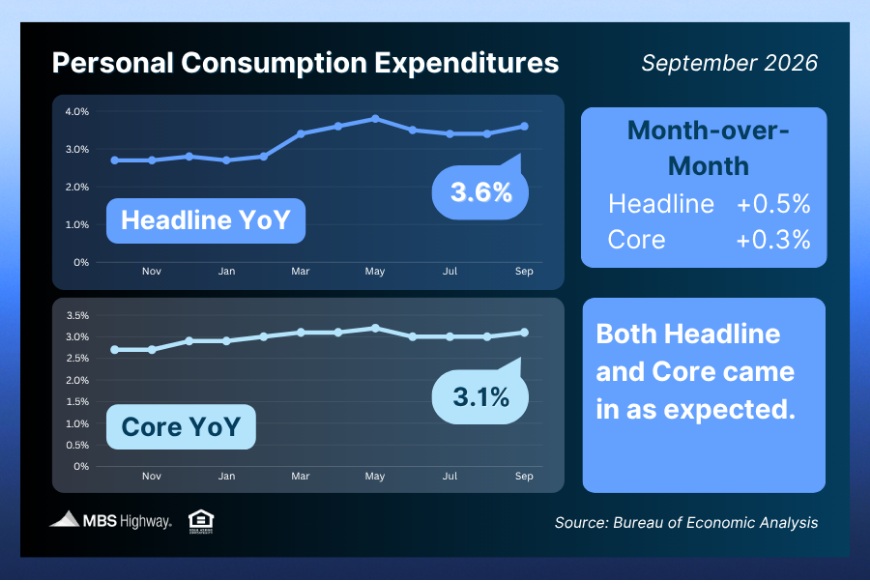 While the labor market is showing signs of cooling, inflation continues to be something the Federal Reserve is watching closely, and the PCE price index is their favored indicator. In September, core PCE, which excludes the volatile food and energy components, was 3.1% higher than a year ago, up slightly from August. Progress toward the 2.0% target of the Fed has been challenging, and this level has not been seen since February 2021.
Gross Domestic Product (GDP) is the broadest measure of economic activity. During the third quarter of 2026, U.S. GDP grew at an annualized rate of 3.4%, above the consensus forecast and up from 2.2% in the second quarter. Consumer spending and business investment remained solid, with much of the business growth tied to continued investment in artificial intelligence. Business spending on mostly technology equipment surged 21%, the most since 2020.
Bottom Line: Expect more volatility in mortgage rates as investors weigh comments from Fed officials, upcoming economic reports, and changing oil prices tied to the conflict in the Middle East. For homebuyers and homeowners watching rates, inflation data will be especially important in the weeks ahead.
Next Week
Looking ahead, the conflict in the Middle East and oil prices will remain a major focus. For economic reports, the ISM national manufacturing sector index will be released on Monday and the services sector index on Wednesday. JOLTS and the Trade Deficit will come out on Tuesday. The key Employment report will be released on Friday, and these figures on the number of jobs, the unemployment rate, and wage inflation are always closely watched.
Until next week….

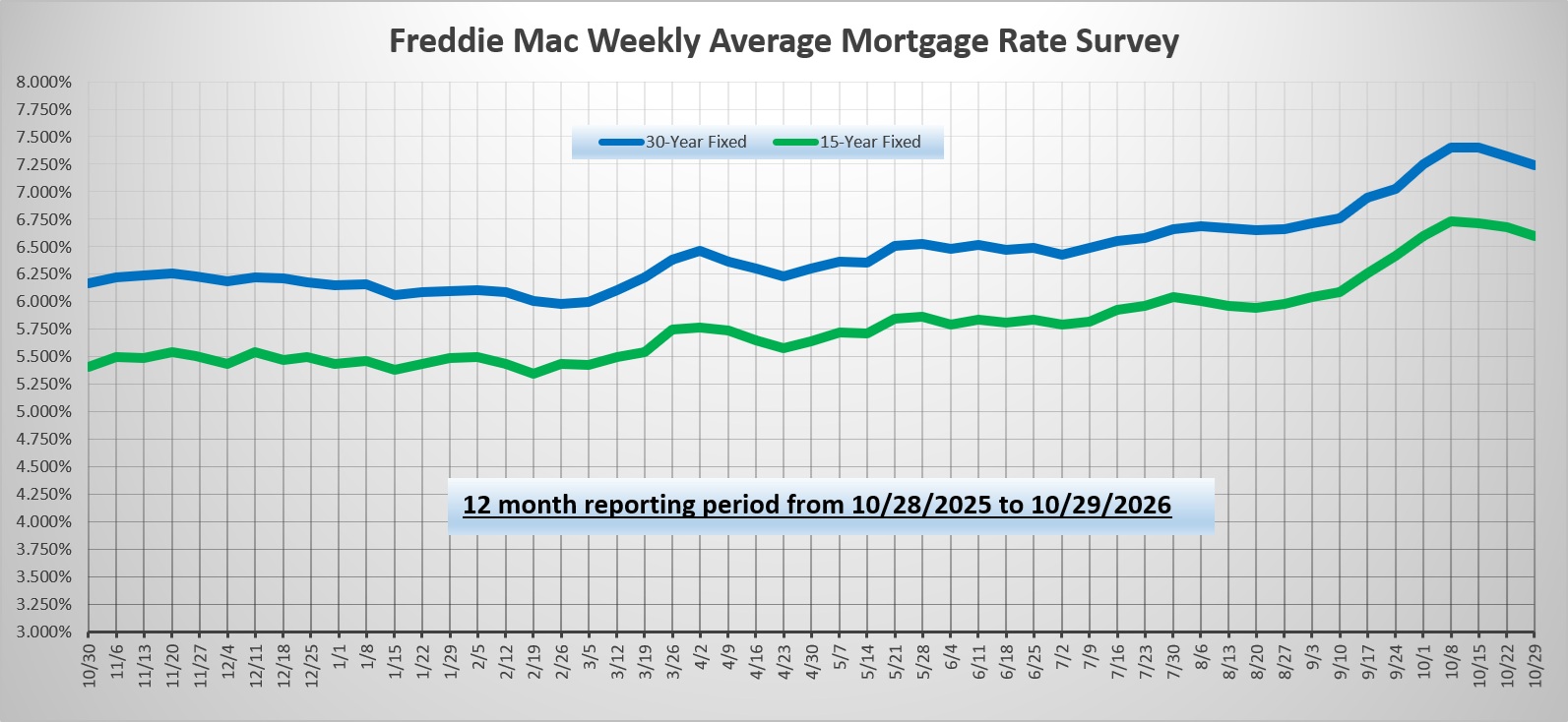
*** Please note that Freddie Mac publishes their weekly rate report on Wednesday mornings from data received Monday and Tuesday.
The graph above is intended to shown rate trends, and not “today’s current rate”. ***
Reviews From Our Past Clients
With every client, we promise to provide you with a comprehensive analysis of your mortgage needs, the best service possible, and the best rates we can find. We make it our mission to have every transaction close with our clients happy with the service we provided. Browse through the hundreds of reviews we’ve received from our clients posted on both Google and Zillow.com, and read what they thought of their experience using Hawaii Mortgage Company.
Google Link:
Hawaii Mortgage Company Review on Google.com
Zillow.com Link:
Hawaii Mortgage Company Reviews on Zillow.com
Our Rate Quote System is Available to You
Our automated rate quoting system is live. Now you can check rates and try different scenarios 24-hours a day. Remember, it’s just a computer. For non-standard rate quotes, such as construction, vacant land, and other specialty programs, you’ll still need to give a call.
Here’s the link: https://www.hawaiimortgage.net/todays-rates/

Do you think all lenders are the same?
There is a difference when you use Hawaii Mortgage Company for your financing. Here’s a short video telling you why:

Broker vs. Banker?
Click the link below to get a quick lesson on why working with a Mortgage Broker will benefit you on your next transaction.


